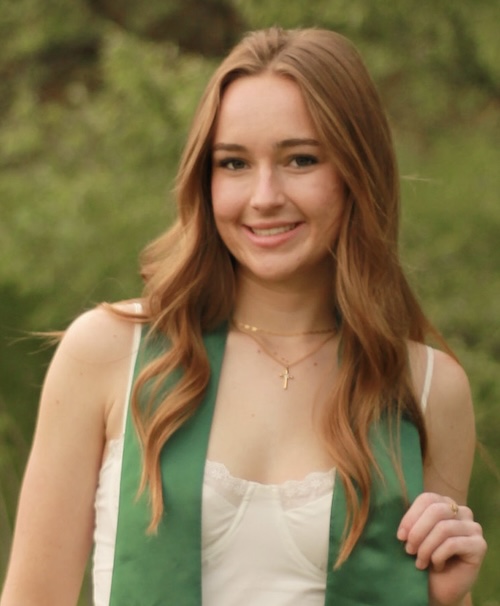
My experience in the Doyle Dialogue Fellows program gave me a deeper appreciation for hearing other perspectives on campus as well as the ability to express my own thoughtfully and constructively. At first glance, dialogue may seem easy, obvious, or even inconsequential; however, this fellowship has shown me the intricacies and challenges of dialogue and equipped me with the skills to engage in dialogue across differences.
Dialogue happens all the time. Every small conversation, moment of listening to a friend's story, or high-stakes, high-emotion debate involves different forms of dialogue. How we express ourselves and listen to others' ideas is not nearly as easy as I originally assumed. I learned how to listen deeper, make others feel heard, and not presume that others fully understand my perspective. I am grateful for the opportunity to have gained a deeper appreciation for engaging in dialogue through the fellowship.
I really appreciated how each method gave me a different skill, each of which can be put together in different scenarios. In Your Shoes™ gave me an appreciation for the power of listening to someone so deeply that you pick up on their “like’s,” their “ums,” and their tone. The concept of demonstrating understanding helped me realize that we might not always articulate our beliefs clearly, and it takes clarification to truly reach the bullseye of purposeful understanding. Additionally, the technique of following meaning reminded me to be intentional about understanding someone's interest and not necessarily my own. I have appreciated how these tools have made me a more effective communicator and listener. When I engage in dialogue now, I find my beliefs to be more nuanced, and my perspective to be wider in the end.
I see this fellowship being applicable in many areas of my life. Socially, I have found myself to be a better friend and student, as well as more prepared to pursue a future in international conflict resolution. I did not originally realize that listening is as important, if not more important, than speaking when engaging in dialogue across differences. I have found myself being a more genuine listener to my friends. I remember to make eye contact and give them my attention while listening and to ask questions not based on my interests but based on what seems most important to them. And finally, I repeat what I've heard and try to make them feel understood. While in practice this is much more subtle and natural than in the workshops, I have found it to be very fulfilling and practical in more areas of my life than I could have predicted.
Additionally, this fellowship is very important for Georgetown. There are so many opportunities for fellows to utilize these skills to make the campus a more diverse and safe space for ideas. The religious plurality of Georgetown is an opportunity I am interested in pursuing as a focus for dialogue across differences. Politically, in the heart of DC, where many students will pursue careers in political leadership, the skills to understand diverse perspectives and cultivate conversations of understanding are so important. Religion and politics also often intermix and are the two topics I find to be the most polarizing, and students are not equipped with the skills to confidently engage in these conversations for fear of saying the wrong thing or lacking understanding. And finally, Georgetown has such a diverse student body from across the United States and internationally. Even things as small as cultural norms, socioeconomic backgrounds, and lived experiences can be so different. I appreciate and am able to engage with these differences after the methods I learned in the fellowship.